
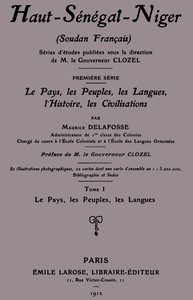
Haut-Sénégal-Niger (Soudan français), Tome 1 (de 3): le pays, les peuples, les…
Let's be clear: this is not a novel. 'Haut-Sénégal-Niger' is the first volume of a massive three-part study written by French colonial administrator and ethnographer Maurice Delafosse. Published in the early 1910s, it was meant to be the definitive guide to a huge chunk of West Africa under French control.
The Story
Think of it as a very detailed, early 20th-century travelogue and encyclopedia mashed together. Delafosse sets out to systematically describe the French Sudan (roughly today's Mali and parts of neighboring countries). He starts with the physical lay of the land—rivers, climate, soil. Then, he gets to the heart of it: the people. He doesn't just list tribes; he tries to explain their histories, their social organization, their languages, and their customs. He writes about farming techniques, trade routes, and local governance. The 'plot' is the journey of understanding itself, as Delafosse pieces together a portrait of a region most of his European audience would have seen only as a blank space on a map or a source of raw materials.
Why You Should Read It
This book is a trip back in time, but not in the way you might expect. Yes, it's a primary source from the colonial era, and you have to read it with that critical lens. But what grabs me is the audience within the audience. On one level, Delafosse is writing for his bosses in Paris. On another, he seems to be writing for himself, trying to make sense of a world far more intricate than colonial stereotypes allowed. You can see his genuine curiosity pushing against the limits of his own time and position. He makes mistakes, his framework is dated, but the effort to document and understand is palpable. It gives you a weird, double-vision look at history: seeing a region through the eyes of a man who was both an agent of empire and a dedicated student of its cultures.
Final Verdict
This is a niche but fascinating read. It's perfect for history buffs, students of colonialism, or anyone interested in West Africa who wants to go beyond simple narratives. It's not a light read—it's dense and detailed. But if you're patient, it offers a raw, unfiltered look at how knowledge was produced in the colonial age. You won't find a thrilling adventure story, but you will find a document that is, in itself, a historical artifact full of contradictions and insights. Approach it as a conversation with the past, and you'll be rewarded.
Jackson Jackson
3 months agoThe layout is very easy on the eyes.
Aiden Brown
5 months agoAfter finishing this book, the character development leaves a lasting impact. Definitely a 5-star read.
Kenneth Jones
1 year agoFast paced, good book.