
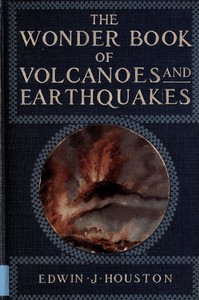
The Wonder Book of Volcanoes and Earthquakes by Edwin J. Houston
Let's be clear from the start: this isn't a novel. There's no main character, unless you count the Earth itself. 'The Wonder Book of Volcanoes and Earthquakes' is a guided tour of our planet's most violent geology, written with the wide-eyed wonder of the early 20th century. Houston takes you on a journey from the basics of what a volcano is, to dramatic accounts of historic eruptions like Vesuvius and Krakatoa. He explains earthquakes not as random acts, but as the Earth 'settling' its gigantic, moving puzzle pieces. The science is explained through simple experiments you could almost do at home, comparing the Earth's crust to cracking ice or a pot boiling over.
Why You Should Read It
This book's magic is in its perspective. Reading it in the 21st century, we know about plate tectonics—a theory that didn't exist when Houston wrote. So you get this fascinating glimpse into the cutting-edge science of 1907. He talks about earthquakes being caused by gas explosions underground or vast, collapsing caverns. It's not wrong in a frustrating way; it's a snapshot of brilliant minds piecing the puzzle together with the tools they had. His awe is contagious. When he describes the 1906 San Francisco quake, you feel the contemporary shock and the urgent need to understand. It's a humbling reminder of how much we've learned, and how brave it is to try and explain the unexplainable.
Final Verdict
This is a perfect read for curious minds who love science, history, or both. If you're a fan of books like 'A Short History of Nearly Everything' and enjoy seeing how scientific understanding evolves, you'll be glued to this. It's also great for anyone who just thinks volcanoes are cool. The language is old-fashioned but clear and full of genuine excitement. It's not the book to grab for current, graduate-level geophysics. But if you want to feel the ground shake under the feet of science a century ago, and share in that moment of discovery, this wonder book is a true treasure.
Paul Ramirez
1 year agoAs someone who reads a lot, the arguments are well-supported by credible references. Don't hesitate to start reading.


Logan Martin
1 year agoThis book was worth my time since the pacing is just right, keeping you engaged. I learned so much from this.